She feeds twelve kids and files paperwork for every bite. Tally does the counting.
A hands-free agent for home child care providers. Photograph the plate, say who is here, and the meal record, the attendance, the ratio check, the notes home and the monthly claim are done, correctly, before the food is cold.
97,000 licensed child care homes closed in twelve years Paperwork is the barrier state agencies name most Claims computed in AgentCore Code Interpreter
The paperwork happens at nine at night, and that is why it goes wrong.
A licensed family child care provider looks after four to twelve children in her own home. To be paid for the meals she serves, she must log every meal for every child by component under the federal food program. Since 2024 she must also document actual daily attendance for every subsidised child. She does all of it after the last child goes home.
Licensed family child care homes fell by half between 2005 and 2017,
more than 97,000 of them. Providers serving subsidised children fell 51 percent.
Reference 1
Almost 80 percent of state agencies name burdensome paperwork as the
top barrier to food program participation.
Reference 2
One lunch a day that fails the log, for six children, over 22 serving
days, at this year's tier 1 rate of 3.31 dollars.
Reference 6
Rosa runs a licensed home in Texas with nine children on a normal day and twelve after school. Last month a snack was rejected because the log showed one component. There were two. She forgot to write the second one down at twenty to ten at night.
On 19 August 2026 the National CACFP Association published a report on this, called Stretched Thin: The Administrative Burden of the CACFP in Family Child Care Homes. Reference 4 Tally is built for the problem that report describes.
Her hands are full. So there is nothing to type.
Say who is here
"Maya's here, Leo's here, Ava's mom said she's sick, Mateo's coming at eight." Attendance, the subsidy check and the ratio for the rest of the day, from one sentence.
Photograph the plate
The agent names the foods, maps them to components, and checks the meal pattern for every age group at the table. It never estimates portions.
Fix it while it is on the table
"Add milk and this breakfast qualifies." Not a rejection next month, when nothing can be done about it.
Approve, do not type
In the evening the notes home are drafted from what she already said, the claim builds itself, and she gets at most two questions.
When it is not sure, it asks
A pale liquid in a bowl could be milk or water, and the two are treated differently. Below its confidence threshold the agent leaves the item out of the record and asks one question, because guessing a component into compliance would create a false claim.
Allergies are checked before anything is written
Every food on the plate is checked against every present child's allergies first. In the demo it catches peanut butter in a bowl of porridge, on a real photograph, without anyone having planned it.
Play the day.
You are Rosa on a Tuesday in September. Press the steps in order and watch a real vision model read real photographs and a versioned rulebook decide what gets paid.
Rosa and every child are fictional. The photographs are real, openly licensed pictures of real food.
Three things a child care app does not do.
It works without hands
A camera and a voice. Two buttons for the moments a hand is free, and everything else spoken. Existing tools are forms, and forms get filled at nine at night, which is exactly when the mistakes happen.
It checks the rule before the meal ends
Reimbursability is decided at the table, with the smallest fix named out loud, rather than discovered at claim time when nothing can be done. Every verdict records the rule version it was decided under.
It uses the half of food vision that works
Models are good at naming foods and poor at estimating grams. The food program only needs components. So Tally identifies components, refuses to estimate portions, and says so plainly rather than quietly overreaching.
What about KidKare and the others?
| Tool | What it does well | What it does not do |
|---|---|---|
| KidKare by Minute Menu | The food program standard, used by tens of thousands of homes, with thorough claim edit checks. | Every meal is typed into a form, and its checks run at claim time, when a missing component can no longer be added. |
| brightwheel, Playground, Procare | Run centres well: billing, enrolment, ratio tracking, CACFP menus. | Assume somebody at a desk. A provider with a toddler on each hip is not that person. |
| Paper and a binder | What many home providers actually use. | Everything. This is the binder, filled in by a photograph and a sentence. |
Tally exports in a format a sponsor already using KidKare can accept. That is deliberate: the aim is that her records are usable tonight, not that she switches systems.
Two shapes, because the day and the evening are different problems.
During the day the provider is standing there waiting, so the work is request driven and shallow: one specialist agent called as a tool. In the evening it is a fixed pipeline whose steps feed each other, so it is a Strands Graph.
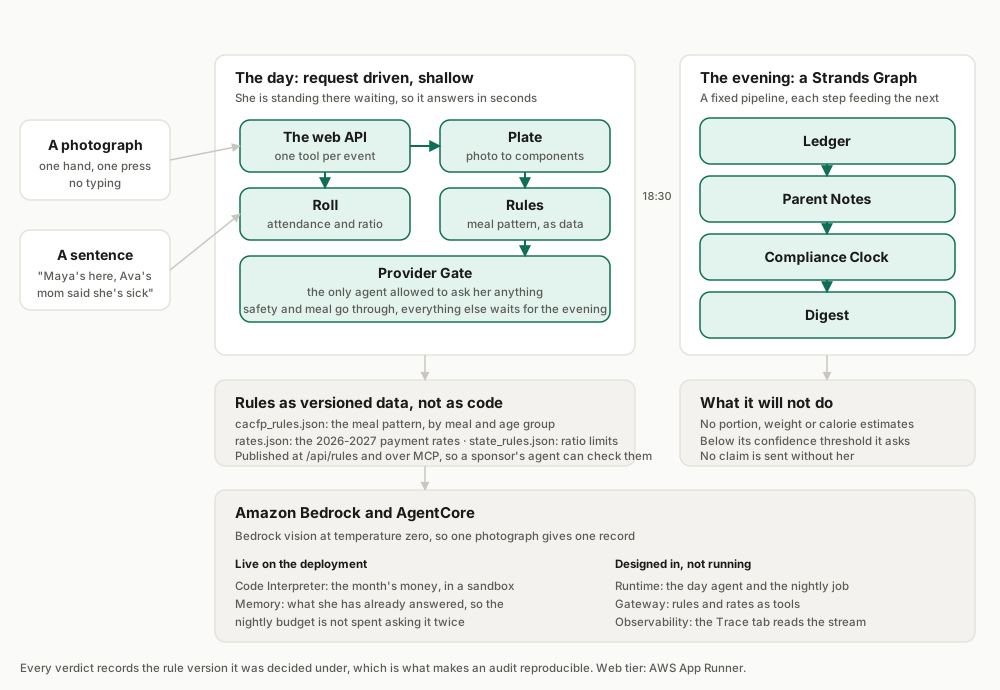
Plate
Photograph to components, with a confidence gate that asks rather than guesses.
Rules
The meal pattern as versioned data. Deterministic, so the same plate always gets the same answer.
Roll
A spoken sentence into attendance, a subsidy check and a ratio look ahead.
Provider Gate
The only agent allowed to ask her anything, with the budget enforced in code.
Ledger
The daily maximum, the month's claim, and what the unpaid meals cost.
Parent Notes
One short note per child, in each family's language, from the record only.
Code Interpreter, live
The month's claim is computed there, by the same kernel.py the local path imports. Memory is live too: what she has already answered is written there, keyed on the child and the weekday, so tomorrow does not spend a question on it. Gateway and Runtime are designed in.
Published rules
The exact rules data is served at /api/rules so a sponsor can check it against USDA, and over the Model Context Protocol so a sponsor's own agent can verify a claim without trusting ours.
For judges.
Everything the rubric asks for, in rubric order, each linked to the evidence.
| Criterion | How Tally addresses it | Evidence |
|---|---|---|
| Technical implementation | A Strands Graph for the evening pipeline and a shallow orchestrator for the live day, because they are different problems. Bedrock vision at temperature zero with a confidence gate. Rules and rates as versioned data behind a tool, not as code. 97 tests plus a published vision eval. | Agent trace API and code |
| Design | A product built around one physical constraint: she has no free hands. Two large buttons, spoken confirmation mirrored as text, an evening digest, a month view, a sponsor export. Light and dark, phone first, an explanation button on every term. | The product |
| Potential impact | Six cited sources including a federal report to Congress and a sector report from two weeks before the deadline, and the impact in money at this year's published rates. | The problem References |
| Creativity and originality | Fix at the table rather than reject at claim time. A deliberate refusal to estimate portions, using only the half of food vision that is reliable. An agent measured by how rarely it interrupts. | What is different |
| Presentation | The demo below is the same Tuesday the submission video walks through, and you can play it yourself rather than watch someone else press the buttons. It runs from the morning roll call to the claim being ready at five past six instead of half past nine. The video itself is linked from the Devpost submission. | Play the day |
Licence: MIT, in the repository root and shown in the About panel of the GitHub repository. All code was written
during the submission period. Photograph credits are in data/plates/ATTRIBUTION.md.
The API.
The endpoint worth integrating is one line: send a photograph, get a compliant meal record. Generate a key and call it yourself, from here or from your terminal.
Call it
curl -X POST http://localhost:8001/api/meals \
  -H "x-api-key: YOUR_KEY" \
  -F "photo=@lunch.jpg" -F "meal_type=lunch"

# -> components, reimbursable, smallest_fix,
#    rule_version, questions
Use the key from the button above in place of YOUR_KEY, or leave the header off entirely. Full schema at /docs. The rules themselves are at /api/rules, so a sponsor can check them against the USDA tables.
Or run the whole thing yourself
git clone <repo> && cd tally
uv venv && uv pip install -e ".[dev]"
python -m tally.data.fetch_plates
python -m tally.data.make_plates
python -m tally.data.generate
uvicorn tally.api:app --port 8001
Then open http://localhost:8001. AWS credentials with Amazon Bedrock access are needed for the vision step.
| Endpoint | What it does |
|---|---|
POST /api/meals | Send a photograph. Returns the components, whether it is reimbursable, and the smallest fix. |
GET /api/state | The whole day: children, ratio, meals, questions, notes, month. |
GET /api/rules | The exact meal pattern data, payment rates and state ratio tables in force. |
GET /api/month | The claim: lines, total, and what the unpaid meals would have paid. |
GET /api/trace | Every agent step, including the decision whether to ask. |
POST /api/answer | Answer a question Tally asked. |
What it will never do.
- It never photographs children. The camera frames the plate. No picture of a child is stored.
- It never submits a claim by itself. The provider reviews the month and presses send.
- It never guesses a component into compliance. Below its confidence threshold it leaves the item out and asks.
- It never estimates portions or calories. It identifies components, which is what the food program requires.
- It never asks more than two questions a day outside a safety alert or a meal that can still be fixed. Enforced in code.
- It never invents a rule. If a state's ratio table is not in the rules file, it refuses rather than guessing, because a wrong limit is worse than no answer.
References.
- HHS Administration for Children and Families, Office of Child Care, "The Decreasing Number of Family Child Care Providers in the United States". acf.gov
- "Barriers to Participation in the Child and Adult Care Food Program for Early Childhood Care Providers", American Journal of Public Health, 2023. ajph.aphapublications.org
- "The Child and Adult Care Food Program: Nutritional Benefits and Barriers Hindering Participation by Home-Based Childcare Providers", 2023. PMC10733890
- National CACFP Association, "Stretched Thin: The Administrative Burden of the CACFP in Family Child Care Homes", 19 August 2026. cacfp.org
- USDA Food and Nutrition Administration, "Report to Congress: Reducing Paperwork in the Child and Adult Care Food Program". fna.usda.gov
- USDA Federal Register, Day Care Home Food Service Payment Rates, 1 July 2026 to 30 June 2027. fna.usda.gov
- USDA Food and Nutrition Administration, "Nutrition Standards for CACFP Meals and Snacks". fna.usda.gov
- "A comparative study of vision-language models for food ingredient recognition and nutrient estimation", 2026. sciencedirect.com
- Texas Health and Human Services, minimum standards for licensed and registered child care homes.
- Gloria Mark, University of California Irvine, research on the cost of interruption and recovery of focus.
- Strands Agents SDK documentation. strandsagents.com
- Amazon Bedrock and AgentCore documentation. docs.aws.amazon.com